


THE HISTORY OF THE SWISS GUARD
The history of the Swiss Guards in the service of the Kings of France is part of a long-standing relationship between the French monarchy and the Swiss cantons. From the 15th century onwards, Swiss soldiers gained a remarkable reputation throughout Europe for their courage and discipline. This reputation was notably forged during the Battle of St. Jakob an der Birs in 1444, near Basel.

Claude-Nicolas MALAPEAU (engraver), An infantry review in the courtyard of the Palace of Versailles, among promenaders, with the Avenue de Paris in the background, 1775–1804, hand-coloured etching. Versailles, Palace of Versailles and Trianon National Museum, INV.GRAV 861.
On the left of the scene can be seen the French Guards, and on the right, facing them, the regiment of the Swiss Guards.
The origins of a brotherhood in arms
On 26 August 1444, during the war between the Swiss Confederates and the Habsburgs, a small force of around 1,500 Swiss soldiers encountered, near St. Jakob an der Birs, on the outskirts of Basel, a much larger army commanded by the Dauphin of France, the future Louis XI. This French army, sent to support the Holy Roman Emperor against the Swiss, numbered approximately 20,000 to 30,000 men.
Despite the overwhelming numerical superiority of their adversaries, the Confederates refused to withdraw. They fought with extraordinary determination, resisting for several hours and inflicting heavy losses on the French troops before being almost entirely annihilated.
King Louis XI, impressed by their military qualities, decided to recruit Swiss soldiers into his service. He was thus one of the first French sovereigns to conclude agreements with the Swiss cantons to ensure their engagement in the armies of the kingdom.
By the end of the 15th century, the Swiss cantons had become a major military power in Europe. Their victories over the Duke of Burgundy — at Grandson, Morat and Nancy (1476–1477) — brought widespread fame to Swiss arms across the continent.
Louis XI quickly understood the strategic value of these troops. He encouraged the recruitment of Swiss soldiers and reorganised the French infantry by drawing inspiration from their methods. Thus emerged the first permanent infantry units, the predecessors of the French regiments.
.jpg)
Portrait of Louis XI
Oil on canvas attributed to Jacob de LITTEMONT
(c. 1469)
The Hundred Swiss and the Strengthening of the Alliance
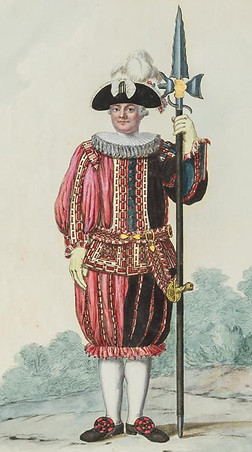
Hundred Swiss in ceremonial dress, circa 1786.
Illustration by Nicolas HOFFMANN
Even before the creation of the regiment of the Swiss Guards, the monarchy established a prestigious unit composed of Swiss soldiers: the Company of the Hundred Swiss, instituted in 1492 by Charles VIII.
This unit very early symbolised the trust placed by the Kings of France in soldiers from the Swiss cantons.
Originally composed of one hundred carefully selected men, they were entrusted with the inner and ceremonial guard of the sovereign. Present in the royal palaces and during major court ceremonies, they fully belonged to the King’s Military Household and formed what was known as the “Inner Guard”.
The Swiss Guards, on the other hand — which our association represents — constituted a true infantry regiment of around 2,000 men. A disciplined fighting force, renowned for its loyalty, it ensured the outer guard of the royal residences, took part in military campaigns and also carried out policing duties beyond the palaces. The Swiss Guards thus formed the “Outer Guard”.
After the Battle of Marignano, King Francis I concluded with the cantons the Perpetual Peace of 1516, followed in 1521 by a treaty of military alliance.
These agreements established a lasting framework for the service of Swiss troops in the French army, known as foreign service.
The Creation of the Swiss Guards regiment
It was under the reign of Louis XIII, in 1616, that a Swiss infantry regiment officially received the name of Swiss Guards.
Although it did not formally belong to the King’s Military Household (this would only occur under the reign of Louis XV), the regiment nevertheless fulfilled its functions and became one of the most prestigious corps in the service of the monarchy. The soldiers were recruited in Switzerland, and the officers themselves came from the Swiss cantons, in accordance with the capitulations concluded with France.
What were the capitulations? They were treaties concluded between the recruiting sovereign and the Swiss cantons. These agreements precisely defined the conditions of service: the number of soldiers provided, their pay, their privileges, as well as the organisation of the units. They notably ensured that Swiss regiments remained commanded by Swiss officers and preserved their military traditions. This system allowed the Swiss Confederation to supply troops to its allies while maintaining a degree of autonomy for its soldiers serving abroad.
For a large part of the Ancien Régime, the Swiss Guards were stationed in the vicinity of the capital. Before the construction of barracks in the mid-18th century, they were often billeted with local inhabitants in several towns of the Île-de-France region, including Rueil, Courbevoie, Issy, Colombes, Vanves and Saint-Denis.
This long-standing presence fostered close ties with the local populations. The soldiers took part in the economic and social life of these communities, and many marriages united Swiss soldiers with French families. From 1755 onwards, under the reign of Louis XV, several barracks were built to house the troops, notably in Rueil, Courbevoie and Saint-Denis. In some towns, the Swiss Guards represented a significant proportion of the population.
For more than three centuries, Swiss soldiers held an important place within the French armies. It is estimated that around one million Swiss served the Kings of France between the 15th and 18th centuries, many of whom perished in battle or from their wounds.
The regiment of the Swiss Guards distinguished itself in particular through its discipline and loyalty. Charged with the protection of the sovereign, it also accompanied the French armies during numerous campaigns.
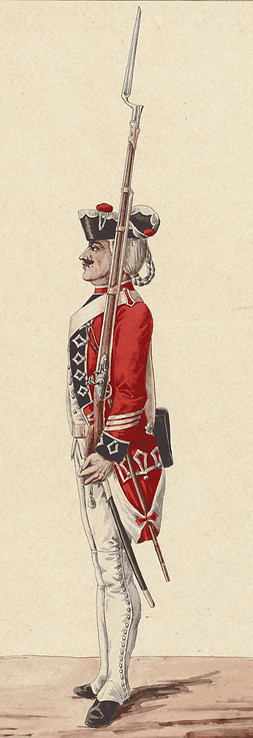
Corporal of the Regiment of the Swiss Guards,
in full dress uniform, circa 1780.
Illustration by Nicolas HOFFMANN
A Tragic Yet Glorious End

Schweizer Soldat der Königlichen Garde (in Rot) und Soldat des Regiments Hohenlohe (in Blau), 1826.
The loyalty of the Swiss Guards to the monarchy found its most tragic expression during the events of 10 August 1792. On that day, around 800 to 900 Swiss Guards defended the Tuileries Palace, residence of the royal family, against the revolutionary insurrection. After several hours of fighting, King Louis XVI ordered his soldiers to cease fire and withdraw.
Many of them were then killed during the assault or massacred after their surrender. This episode deeply marked the history of the regiment and became one of the most enduring symbols of military loyalty to the sovereign.
The fall of the monarchy in 1792 brought about the disappearance of the Swiss Guards regiment as it had existed under the Ancien Régime.
However, the tradition of Swiss troops in the service of France did not disappear immediately. Under the Empire and the Restoration, several Swiss regiments continued to serve in the French armies.
It came to a definitive end with the July Revolution of 1830, which led to the dissolution of these regiments and thus brought to a close nearly four centuries of Swiss military service to the Kings of France and the Empire.
However, the spirit of these foreign soldiers in the service of France did not disappear with the dissolution of the Swiss regiments. At the same time, the Hohenlohe Regiment, composed of foreign volunteers but containing no Swiss soldiers in its ranks, likewise perpetuated the tradition of foreign service within the French Army. Dissolved in 1831, it was soon succeeded by an institution destined to become famous: the French Foreign Legion. Although not a direct heir to the Swiss Guards, the Legion forms part of the continuity of those foreign corps which, for centuries, served France with honour and devotion.
In a memory-laden echo, the motto adopted by the French Foreign Legion in 1921 reprises, with the words reversed, the one that embodied the spirit of the Swiss Guards:
"HONOUR AND FIDELITY"

Napoleon Bonaparte at the storming of the Tuileries, oil on canvas by Maurice RÉALIER-DUMAS, 1888